
Trailer Tow Guide: A Comprehensive Overview
Navigating the world of trailer towing demands knowledge; this guide provides essential insights for safe, efficient hauling and responsible vehicle operation.
Trailer towing extends a vehicle’s capabilities, enabling the transport of goods, equipment, and recreational items beyond the vehicle’s inherent capacity. However, it’s far more complex than simply attaching a trailer and driving. Successful and, most importantly, safe trailer towing requires a thorough understanding of vehicle limitations, proper equipment, and established best practices.
This guide serves as a foundational resource for both novice and experienced towers. We’ll delve into critical concepts like towing capacity, weight ratings, and the various types of trailers available. Furthermore, we will explore the necessary equipment for secure connections and controlled towing. Ignoring these aspects can lead to dangerous situations, vehicle damage, and legal repercussions.
Ultimately, mastering trailer towing is about responsibility – protecting yourself, your vehicle, and others on the road. Let’s begin building that foundation of knowledge.
Understanding Towing Capacity
Towing capacity represents the maximum weight a vehicle can safely pull. This isn’t a single, fixed number; it varies based on vehicle configuration, engine type, drivetrain, and axle ratio. Exceeding this limit severely compromises handling, braking effectiveness, and overall vehicle control, creating a significant safety hazard.
Manufacturers determine towing capacity through rigorous testing, considering factors like structural integrity, cooling system efficiency, and brake performance. Never assume a vehicle can tow a certain weight without verifying the manufacturer’s specifications – found in the owner’s manual or on the vehicle’s doorjamb sticker.
It’s crucial to remember that towing capacity is just one piece of the puzzle. Other weight ratings, like GVWR and GCWR (discussed later), also play vital roles in determining a safe towing setup. Always prioritize safety and adhere to published limits.
Gross Vehicle Weight Rating (GVWR)
Gross Vehicle Weight Rating (GVWR) is the maximum permissible weight of the vehicle itself – including the chassis, body, engine, fluids, passengers, and cargo – as specified by the manufacturer. It’s a critical figure for safe operation and legal compliance. Exceeding the GVWR stresses the vehicle’s components, potentially leading to mechanical failure and compromised handling.
The GVWR isn’t simply about how much weight the vehicle can carry; it’s about the maximum weight it’s designed to carry safely. This rating considers the vehicle’s suspension, brakes, and frame strength. You can find the GVWR on a sticker typically located on the driver’s side doorjamb.
Properly calculating and adhering to the GVWR is essential, especially when preparing for towing. Remember to factor in the weight of all passengers and cargo before adding the trailer’s weight into the equation.
Gross Combined Weight Rating (GCWR)

Gross Combined Weight Rating (GCWR) represents the maximum allowable weight of a vehicle and a fully loaded trailer combined. It’s a crucial specification for safe towing, dictated by the vehicle manufacturer, and considers the vehicle’s structural limits and braking capabilities when handling a substantial load.
Unlike GVWR, which focuses solely on the vehicle, GCWR encompasses everything – the vehicle’s weight (including passengers and cargo) plus the trailer’s weight (including its cargo). Exceeding the GCWR can severely compromise vehicle control, braking performance, and overall safety.
Finding the GCWR is usually found in the vehicle’s owner’s manual or on a dedicated sticker. Always verify this number before towing to ensure you remain within safe operating parameters. Calculating GCWR is vital for responsible towing practices.
Calculating Available Towing Capacity
Determining your vehicle’s available towing capacity isn’t simply reading a number; it requires a calculation. Start with the Gross Combined Weight Rating (GCWR) and subtract the Gross Vehicle Weight Rating (GVWR). This difference represents the maximum weight your vehicle can potentially tow.
However, this isn’t the final figure! You must also account for the weight of passengers and cargo already in your vehicle. Subtract this combined weight from the GCWR-GVWR difference. The resulting number is your true, available towing capacity.

Formula: Towing Capacity = (GCWR ─ GVWR) ─ (Vehicle Weight + Cargo Weight). Always err on the side of caution and stay well below your calculated capacity for a safer towing experience.
Types of Trailers & Their Uses
Trailers come in a vast array of designs, each suited for specific hauling needs. Understanding these differences is crucial for selecting the right trailer for your task. Broadly, they fall into several categories, defined by their construction and intended purpose.
Open trailers, like utility trailers, are versatile for general cargo. Enclosed trailers offer protection from the elements and security for valuable items. Specialty trailers, such as boat trailers or car haulers, are designed for specific loads.
Recreational trailers, including travel trailers and fifth wheels, provide living accommodations while traveling. Choosing the correct trailer type ensures safe and efficient transport of your goods or recreational needs.
Utility Trailers: For General Hauling
Utility trailers are the workhorses of the towing world, renowned for their versatility and affordability. Typically featuring an open deck and low sides, they excel at transporting a wide range of materials – from landscaping supplies and furniture to appliances and construction debris.
These trailers are commonly constructed from steel or aluminum, with weight capacities varying significantly based on size and construction. They often include features like stake sides and ramps for easy loading and unloading.
Their simplicity makes them ideal for homeowners, contractors, and anyone needing a flexible hauling solution. Remember to properly secure your load with straps or tie-downs for safe transport.
Boat Trailers: Specifically Designed for Watercraft
Boat trailers are engineered with the unique needs of watercraft in mind, providing secure and convenient transport to and from the water. Unlike general-purpose trailers, boat trailers feature a bunk or roller system to support the hull, preventing damage during transit.
Key features include carpeted bunks or rollers, a winch for loading, and often, submersible LED lights for nighttime trailering. They are typically constructed from galvanized steel to resist corrosion from saltwater exposure.
Selecting the correct boat trailer requires matching its capacity to the boat’s weight and length. Proper weight distribution is crucial for safe towing, and regular maintenance – including bearing lubrication and tire checks – is essential for longevity.
Travel Trailers & Fifth Wheels: Recreational Vehicle Options
Travel trailers and fifth wheels represent popular choices for recreational vehicle enthusiasts, offering home-like amenities on the road. Travel trailers connect to a vehicle via a ball hitch, while fifth wheels utilize a specialized hitch mounted in the truck bed, providing enhanced stability.
Fifth wheels generally offer more spacious living areas and heavier build quality compared to travel trailers. Both types come in a wide range of sizes and feature layouts, catering to diverse needs and budgets.
Towing these RVs requires a capable tow vehicle with sufficient towing capacity and appropriate hitch setup. Understanding weight ratings – GVWR and GCWR – is paramount for safe operation. Careful planning and adherence to speed limits are also vital.
Essential Towing Equipment
Successful trailer towing relies on having the right equipment. A properly rated trailer hitch is fundamental, matched to your vehicle and trailer weight. Safety chains and a breakaway cable are crucial safety features, providing redundancy in case of disconnection.
Trailer brakes – either electric or surge-activated – are often legally required and significantly improve stopping power. A wiring harness ensures proper functioning of trailer lights (brake, turn, and running lights). Don’t forget a tire pressure gauge to maintain optimal tire inflation for both the tow vehicle and trailer.
Additional helpful items include wheel chocks, leveling blocks, and a lug wrench. Investing in quality equipment enhances safety and simplifies the towing experience.
Trailer Hitch Types (Ball, Pintle, Gooseneck)
Ball hitches are the most common, utilizing a ball mount receiver and a corresponding trailer coupler; they’re versatile for lighter-duty towing. Pintle hitches, often found on heavy-duty trucks, employ a hook-and-loop connection, offering robust durability and off-road capability.
Gooseneck hitches, installed in the truck bed, provide exceptional stability and towing capacity, ideal for large trailers like fifth wheels. They utilize a ball protruding from the bed and a horseshoe-shaped coupler on the trailer. Each type has specific weight ratings and applications.
Choosing the right hitch depends on the trailer’s weight, intended use, and your vehicle’s capabilities. Proper installation is critical for safety and performance.
Trailer Brakes (Electric, Surge)
Electric trailer brakes are activated by a controller in the tow vehicle, sending a signal to electromagnets that engage the trailer’s brakes; they offer precise control and are essential for heavier trailers. Surge brakes, commonly found on boat and utility trailers, operate hydraulically – the trailer’s momentum activates a master cylinder, applying the brakes.
Surge brakes are simpler to install but offer less modulation than electric systems. Trailers exceeding a certain weight require brakes, and often, a breakaway system as well. Proper brake adjustment and maintenance are crucial for safe stopping distances.
Understanding the braking system on your trailer and tow vehicle is paramount for preventing accidents and ensuring a controlled towing experience.

Safety Chains & Breakaway Cables
Safety chains are a critical backup system; they prevent the trailer from completely disconnecting in the event of hitch failure. Always cross the chains beneath the hitch, providing a cradle if separation occurs. Avoid dragging chains – ensure sufficient slack, but not excessive looseness.
Breakaway cables connect the trailer’s emergency brake to the tow vehicle. If the trailer becomes detached, the cable activates the trailer brakes, preventing a runaway situation. Regularly inspect both safety chains and the breakaway cable for wear, corrosion, and proper attachment.
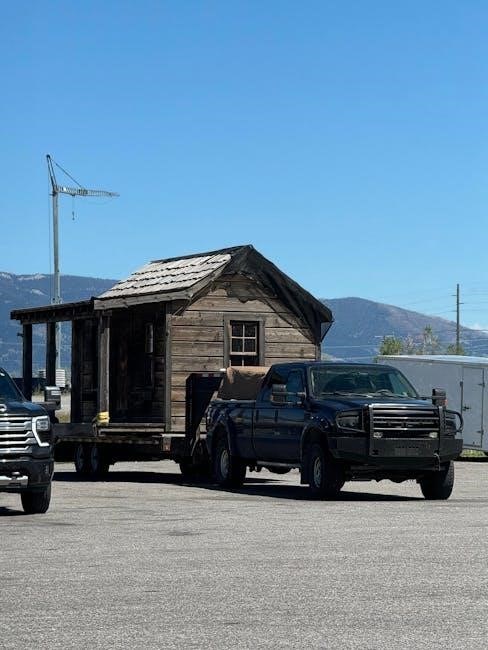
These components are non-negotiable safety features; neglecting them can lead to severe accidents. Proper installation and routine checks are vital for responsible towing.
Connecting the Trailer Safely
Prioritize a level surface when connecting your trailer to the tow vehicle. Engage the parking brake on both vehicles and chock the trailer wheels for added security. Carefully align the hitch ball with the trailer coupler, ensuring a secure and audible latch.
Next, connect the safety chains, crossing them under the hitch as described previously. Verify proper wiring harness connection for lights and brakes. Finally, attach and test the breakaway cable, confirming it will activate the trailer brakes if disconnected.
A thorough pre-trip inspection is crucial. Walk around the trailer, checking tire pressure, lug nuts, and overall structural integrity before each journey.
Hitching Procedures – Step-by-Step
Begin by positioning the tow vehicle directly in line with the trailer. Slowly back up until the hitch ball is aligned under the trailer coupler. Lower the coupler onto the ball with a smooth, controlled motion – you should hear a positive locking sound.
Secure the safety chains, crossing them beneath the trailer tongue. Connect the wiring harness, verifying all lights (brake, turn, running) function correctly. Attach the breakaway cable to the tow vehicle, ensuring it’s securely fastened.
Finally, double-check all connections before driving. Perform a short test drive at low speed to confirm proper operation of the brakes and lights.
Wiring & Lights – Ensuring Proper Functionality
Proper trailer lighting is crucial for safety. Connect the trailer wiring harness to the tow vehicle’s connector, typically a 4-way or 7-way plug. Verify that all lights – brake lights, turn signals, running lights, and reverse lights – are functioning correctly before each trip.
Inspect the wiring for any damage, such as frayed wires or corroded connections. Use dielectric grease to protect connections from corrosion. Consider a wiring harness with a fused connector for added protection.
Regularly test the lights to ensure they remain operational throughout your journey. A faulty light can significantly reduce visibility and increase the risk of accidents.
Towing Best Practices & Safety
Prioritize safety when towing. Always distribute the load evenly within the trailer to maintain stability. Secure cargo to prevent shifting during transit, utilizing straps and tie-downs. Perform a pre-trip inspection, checking tire pressure, lug nuts, and all connections.
Be aware of the trailer’s increased length and width, requiring wider turns and greater stopping distances. Avoid sudden maneuvers and maintain a consistent speed. Regularly check mirrors for traffic and the trailer’s position.

Plan your route, avoiding steep grades and sharp curves whenever possible. Consider weather conditions and adjust your driving accordingly. Fatigue impacts judgment; take frequent breaks on long hauls.
Speed Limits & Following Distance
Adhering to speed limits is crucial when towing; often, these are lower than standard passenger vehicle limits. Posted limits vary by state and sometimes by vehicle combination, so always verify current regulations. Reducing speed provides increased reaction time and control.
Increase following distance significantly – at least double the usual amount. The added weight of the trailer extends stopping distances considerably. Allow ample space between your vehicle and the one ahead to react safely to unexpected events.

Anticipate traffic flow and potential hazards. Avoid tailgating and be prepared for slower acceleration and deceleration. Consistent, predictable driving is key to safe towing.
Turning & Maneuvering with a Trailer
Wide turns are essential when towing. Trailers track tighter than the towing vehicle, requiring a wider arc to avoid contact with obstacles. Plan turns well in advance and signal intentions clearly.
Slow down significantly before entering a turn. Reducing speed minimizes sway and enhances control. Avoid abrupt steering movements, which can destabilize the trailer.
Be mindful of trailer swing, especially in tight spaces. Utilize mirrors effectively to monitor the trailer’s position. When backing, use small, controlled steering adjustments and a spotter if possible. Practice maneuvering in an open area before tackling challenging situations.
Braking Techniques for Trailer Towing
Anticipate stops well in advance when towing a trailer; increased stopping distances are crucial. Apply the brakes smoothly and progressively, avoiding sudden, harsh applications that can cause skidding or trailer sway.
Utilize trailer brakes in conjunction with your vehicle’s brakes. Electric trailer brakes require manual activation, while surge brakes operate automatically with vehicle deceleration. Ensure proper brake controller settings for optimal performance.
Downshifting can assist in slowing the vehicle and reducing brake wear, particularly on long descents. Avoid riding the brakes, as this can lead to overheating and brake failure. Maintain a safe following distance to allow ample time for controlled stopping.
Legal Requirements & Regulations
Compliance with towing laws is paramount for safe and legal operation. Regulations vary significantly by state and even locality, encompassing trailer weight limits, size restrictions, and required safety equipment.
Trailer registration and licensing are often mandatory, depending on the trailer’s weight and usage. Ensure your vehicle’s registration is current and reflects your towing capacity. Some states require a special endorsement on your driver’s license for towing heavier trailers.
Adherence to state-specific laws regarding lighting, braking systems, and load securement is essential. Regularly consult official state transportation websites for the most up-to-date information and avoid potential fines or legal issues.
Trailer Registration & Licensing
Understanding trailer registration requirements is crucial before hitting the road. Many states mandate registration for trailers exceeding a certain weight, often around 2,000 pounds, but specifics differ widely.
Licensing often depends on the Gross Vehicle Weight Rating (GVWR) of the trailer. Heavier trailers may necessitate a commercial driver’s license (CDL) or a specialized endorsement on your existing license. Check your state’s Department of Motor Vehicles (DMV) guidelines.
Registration typically involves providing the trailer’s Vehicle Identification Number (VIN), ownership documentation, and payment of applicable fees. Failure to register can result in fines and legal complications, so prioritize compliance.
State-Specific Towing Laws
Towing regulations are not uniform across the United States; they vary significantly from state to state. These differences encompass speed limits for vehicles towing trailers, lane restrictions on certain highways, and requirements for additional mirrors or flags.
Some states impose stricter rules regarding trailer length, width, and height, while others have specific regulations for transporting oversized or overweight loads. Brake requirements also differ, with some states mandating brakes on all axles above a certain weight.
It’s essential to research the towing laws of every state you plan to travel through. Resources like state DMV websites and trucking associations provide detailed information to ensure legal and safe towing practices.