
Perseus and Medusa: A Comprehensive Overview
Perseus’s tale, involving Medusa’s demise, originates from ancient Greek mythology, documented in various texts and continually reinterpreted across art and modern media.
The Myth’s Origins and Historical Context
The Perseus and Medusa myth deeply roots itself in ancient Greek storytelling, evolving through oral traditions before appearing in written form with poets like Hesiod and Pindar. Some scholars, notably Joseph Campbell, propose links to historical events—specifically, the potential mythologizing of a 13th-century BC temple raid where priestesses wearing Gorgon masks were killed.
The narrative likely reflects anxieties surrounding power, violence, and the dangers faced by heroes in a chaotic world. Early accounts varied, but the core elements—Perseus’s divine lineage, Medusa’s curse, and the heroic quest—remained consistent, shaping its enduring cultural impact.
Early Accounts and Variations
Initial depictions of the Perseus myth appear fragmented across ancient Greek literature. While Hesiod and Pindar offer glimpses, complete narratives emerge later with Roman authors like Ovid in his Metamorphoses. Variations exist regarding the specifics of Medusa’s backstory; some emphasize her initial beauty, while others focus more directly on Poseidon’s violation and Athena’s subsequent curse.
Furthermore, details surrounding Perseus’s quest—the aid received from Hermes, Athena, and the Graeae—differ across tellings, showcasing the myth’s fluidity and adaptability throughout antiquity.
The Role of Joseph Campbell’s Theories
Joseph Campbell, a prominent mythologist, proposed that Perseus’s beheading of Medusa symbolizes a historical event – potentially the sacking of a temple around the 13th century BC. He theorized that Greek invaders killed priestesses wearing Gorgon masks, which became mythologized over time.
Campbell’s comparative mythology approach suggests the myth reflects deeper psychological patterns and societal anxieties, interpreting the hero’s journey as a universal archetype of transformation and overcoming primal fears.
The Birth of Perseus
Danae, impregnated by Zeus, bore Perseus; Acrisius, fearing a prophecy, imprisoned them, casting them adrift in a chest upon the sea.
Danae and Zeus: The Divine Conception
Danae, the daughter of Acrisius, king of Argos, was renowned for her beauty, attracting the attention of Zeus himself. Imprisoned by her father to prevent a foreseen prophecy – that her son would slay him – Zeus visited Danae in the form of golden rain.
This divine encounter resulted in her pregnancy and the subsequent birth of Perseus. Acrisius, enraged and still fearful of the prophecy, refused to acknowledge the child and cruelly confined both mother and son within a wooden chest, casting them adrift upon the sea, hoping for a tragic end.
Acrisius’s Prophecy and Imprisonment
Acrisius, the king of Argos, received a chilling prophecy from the Oracle of Delphi: his own grandson would bring about his demise. Terrified, he imprisoned his daughter, Danae, within a bronze chamber, isolating her from all male contact, hoping to avert the predicted fate.
However, Zeus circumvented this precaution, visiting Danae in a shower of golden rain and fathering Perseus. Upon discovering the birth, Acrisius, fearing the prophecy’s fulfillment, sealed Danae and the infant Perseus in a wooden chest and cast them into the sea.
Rescue and Upbringing in Seriphos
Fortunately, the chest containing Danae and Perseus didn’t meet a watery grave. It washed ashore on the island of Seriphos, where they were discovered by a kind fisherman named Dictys. Dictys, a brother of the island’s king, Polydectes, took them in and raised Perseus as his own son, providing him with shelter and a semblance of a normal upbringing.
Perseus grew into a strong and courageous young man, unaware of his divine lineage and the dangers that lay ahead, all while under the watchful, and sometimes menacing, eye of Polydectes.
Medusa: Before the Curse
Medusa was initially a beautiful mortal woman, renowned for her striking appearance, before a horrific violation and subsequent curse transformed her into a monstrous Gorgon.
Medusa’s Original Form and Beauty
Before her tragic transformation, Medusa possessed remarkable beauty, captivating all who beheld her. Accounts describe her as a stunning maiden with flowing, golden hair – a priestess dedicated to Athena. This initial form is crucial to understanding the depth of her suffering and the injustice of her fate.
Her beauty wasn’t merely physical; it was associated with purity and devotion. This pristine image sharply contrasts with the monstrous depiction she later embodies, highlighting the devastating impact of the events that led to her curse. The loss of this original beauty underscores the myth’s themes of violation and retribution.
The Violation by Poseidon
A pivotal and deeply disturbing event in Medusa’s story is her violation by Poseidon within Athena’s temple. This act, committed against her will, desecrated the sacred space and profoundly angered the goddess. Accounts consistently portray this as a brutal assault, stripping Medusa of her agency and innocence.
The violation isn’t simply an act of lust; it’s a transgression against divine law and a profound disrespect towards Athena. This event serves as the catalyst for Medusa’s horrific transformation, framing her subsequent existence as a consequence of another’s actions, not her own.
Athena’s Transformation and the Gorgon Curse
Outraged by the sacrilege within her temple, Athena didn’t punish Poseidon – a reflection of the gods’ complex power dynamics – but instead directed her wrath upon Medusa. As punishment for the desecration, Athena transformed Medusa into a monstrous Gorgon, with venomous snakes for hair and a gaze that could turn men to stone.
This transformation wasn’t merely physical; it was a complete and utter curse, isolating Medusa and branding her as a terrifying figure. The Gorgon curse represents a tragic consequence of divine intervention and a stark portrayal of victim-blaming within the myth.
Perseus’s Quest: Preparation and Divine Aid
Perseus, tasked with Medusa’s head, received crucial assistance from Hermes and Athena, who gifted him winged sandals and a polished shield for protection.
The Challenge from Polydectes
Polydectes, the king of Seriphos, desired to marry Perseus’s mother, Danae, but faced Perseus’s protective presence. To circumvent this, Polydectes cunningly devised a seemingly impossible task: retrieving the head of Medusa, the Gorgon.
He presented this request as a gift for a prospective bride, knowing its perilous nature would likely result in Perseus’s death. This manipulative scheme aimed to eliminate Perseus, allowing Polydectes to pursue Danae without obstruction. The challenge served as the catalyst for Perseus’s heroic quest, setting him on a path fraught with danger and divine intervention.
Hermes and the Winged Sandals
Recognizing the immense difficulty of Perseus’s quest, the gods intervened to aid him. Hermes, the swift-footed messenger god, provided crucial assistance, gifting Perseus with winged sandals. These magical sandals granted the hero the ability to fly, essential for reaching the remote lair of Medusa and escaping the dangers that awaited him.
Hermes’s gift symbolized divine support and enabled Perseus to overcome a significant obstacle, highlighting the importance of supernatural aid in achieving heroic feats within Greek mythology.
Athena and the Shield
Athena, the goddess of wisdom and strategic warfare, also extended her aid to Perseus. Recognizing the peril of facing Medusa directly, she provided him with a highly polished shield. This wasn’t merely for defense; it functioned as a mirror.
Perseus could safely view Medusa’s reflection, avoiding her petrifying gaze. This gift showcased Athena’s cleverness and her role as a protector of heroes, ensuring Perseus had a chance to succeed in his dangerous quest.
The Graeae: Obtaining Crucial Information
Perseus needed vital information regarding Medusa’s location, and the path to reach her lair. This knowledge was held by the Graeae, three ancient sisters who shared one eye and one tooth between them. Obtaining this information proved difficult, requiring cunning and bravery.
Perseus stealthily stole their shared eye and tooth, holding them hostage until they revealed the route to the Gorgons’ hidden abode, demonstrating his resourcefulness and determination.
The Journey to the Gorgons’ Lair
Perseus faced perilous landscapes and navigated treacherous paths, guided by the Graeae’s directions, to reach the remote and hidden dwelling of the Gorgons.
Locating the Gorgons’ Hidden Abode
Perseus, lacking direct knowledge of the Gorgons’ lair, required assistance. He sought out the Graeae, ancient sisters who shared one eye and one tooth between them. Obtaining information proved difficult, as they were reluctant to reveal the path. Perseus cleverly stole their shared eye and tooth, holding them hostage until they divulged the location – a place beyond the known world, shrouded in darkness and guarded by monstrous creatures. This remote location ensured Medusa’s isolation and the difficulty of her defeat.
Navigating the Perils of the Landscape
Perseus’s journey to the Gorgons’ lair was fraught with danger, extending beyond monstrous guardians. The landscape itself presented significant obstacles – a desolate, rocky terrain bordering the edge of the world. He faced treacherous paths, potentially inhabited by other mythical beasts not explicitly named in accounts. The isolation and darkness added to the peril, demanding unwavering courage and reliance on the divine gifts received from Hermes and Athena to overcome the environmental challenges and reach his destination.
The Confrontation with Medusa
Perseus skillfully utilized Athena’s shield as a mirror, avoiding Medusa’s petrifying gaze, allowing him to approach and ultimately sever her head with a swift strike.
Using the Shield to Avoid Medusa’s Gaze
Perseus received a polished shield from Athena, crucial for his perilous encounter with Medusa. Instead of directly looking at the Gorgon, whose gaze turned onlookers to stone, Perseus ingeniously used the shield as a reflective surface. This allowed him to observe Medusa’s location and movements indirectly, effectively neutralizing her deadly power.
By focusing on Medusa’s reflection, Perseus could navigate the confrontation without succumbing to petrification, a testament to Athena’s strategic aid and Perseus’s cleverness. This tactic was paramount to his success, enabling him to approach and ultimately defeat the monstrous Gorgon.
The Decapitation of Medusa
Perseus, guided by Medusa’s reflection in Athena’s shield, swiftly approached the sleeping Gorgon. With a precise strike using a sickle or sword (accounts vary), he severed Medusa’s head. This act, though brutal, was essential to fulfilling his quest and liberating the land from her petrifying gaze.
The decapitation wasn’t without immediate consequences; from Medusa’s severed neck sprang Pegasus, the winged horse, and Chrysaor, a golden giant, both offspring of Poseidon and the Gorgon. This marked a dramatic and mythical birth from a tragic end.
The Birth of Pegasus and Chrysaor
Immediately following Medusa’s decapitation by Perseus, a remarkable event unfolded: the miraculous birth of Pegasus and Chrysaor. Emerging directly from the Gorgon’s severed neck, these beings represent a potent symbol of liberation and new beginnings arising from a violent act.
Pegasus, the magnificent winged horse, became a favored steed of the heroes, while Chrysaor, a golden warrior, further emphasized the extraordinary nature of their origin. Their birth signifies a complex interplay of death and creation within the myth.
The Aftermath of Medusa’s Death
Perseus, escaping with Medusa’s head, embarked on further adventures, utilizing the Gorgon’s power as a formidable weapon against various foes he encountered.
Perseus’s Escape and Encounters
Following Medusa’s decapitation, Perseus initiated his journey home, encountering several significant events. He famously rescued Andromeda, a princess chained to a rock as a sacrifice to a sea monster, defeating the beast and marrying her.
Further along his path, Perseus confronted Atlas, attempting to trick him into relinquishing his burden, but ultimately transforming the titan into a mountain range with Medusa’s head. These encounters demonstrate Perseus’s growing heroism and the potent power he wielded with the Gorgon’s severed head.
The Use of Medusa’s Head as a Weapon
Perseus strategically employed Medusa’s severed head as a formidable weapon throughout his travels. Its petrifying gaze proved effective against enemies, notably during his rescue of Andromeda, where it subdued potential threats.
The head’s power wasn’t merely destructive; Perseus later presented it to Athena, who affixed it to her aegis, transforming it into a symbol of protection and terror. This illustrates how a tool of destruction could be repurposed for divine defense and symbolic representation.

Medusa’s Head and Athena
Perseus gifted Medusa’s head to Athena, who then placed it upon her aegis, creating the Gorgoneion – a potent symbol of power and protection.
The Gorgoneion: Symbolism and Significance
The Gorgoneion, Medusa’s severed head displayed on Athena’s aegis, transcended a mere trophy; it became a powerful apotropaic symbol. This meant it was believed to ward off evil, offering protection to the goddess and, by extension, to those who invoked her aid.
Its terrifying visage, even in death, instilled fear in enemies. Beyond defense, the Gorgoneion represented Athena’s power over monsters and chaos, signifying her victory over primal forces. Some interpretations suggest it symbolized a religious idea, potentially linked to temple sacks and priestesses wearing Gorgon masks.
Placement on Athena’s Aegis
Perseus gifted Medusa’s head to Athena, who strategically placed it upon her aegis – a fearsome shield or breastplate. This wasn’t simply a display of conquest; it amplified the aegis’s protective capabilities. The Gorgoneion’s terrifying image served as a potent deterrent, paralyzing foes with fear and ensuring Athena’s dominance in battle.
By incorporating the monstrous head, Athena harnessed its power, transforming a symbol of terror into a source of strength and safeguarding her allies. This act solidified her role as a protector and a vanquisher of evil.

Perseus’s Further Adventures
Perseus continued his heroic journey, famously rescuing Andromeda and transforming Atlas into stone, demonstrating his courage and divine favor beyond Medusa’s defeat.
Rescuing Andromeda from the Sea Monster
Perseus, while returning with Medusa’s head, encountered Andromeda chained to a rock as a sacrifice to a fearsome sea monster sent by Poseidon. He bravely intervened, utilizing the Gorgon’s head to petrify the beast, saving Andromeda from a dreadful fate.
This act of heroism led to their marriage, and Andromeda accompanied Perseus on his journey. The rescue highlights Perseus’s continued valor and the potent power derived from Medusa’s severed head, solidifying his legendary status.
The Transformation of Atlas into Stone
During his travels, Perseus came across Atlas, who, refusing hospitality, was punished for his arrogance. Perseus, wielding Medusa’s head, turned Atlas into a mountain range, forever frozen in stone as a stark warning against pride and inhospitable behavior.
This act demonstrates the lasting power of the Gorgon’s gaze, even after Medusa’s death, and Perseus’s ability to utilize it as a formidable weapon against those who deserved retribution.
Interpretations and Symbolism
Medusa often embodies female rage and power, while Perseus represents courage and heroism, exploring themes of violence and the overcoming of monstrous forces.
Medusa as a Representation of Female Rage
Medusa’s transformation into a monstrous Gorgon, following a violation by Poseidon within Athena’s temple, is increasingly viewed as symbolic of female rage born from trauma. This interpretation reframes her monstrous depiction not as inherent evil, but as a consequence of suffering and a justified, albeit terrifying, response to assault.
Her snake hair and petrifying gaze can be understood as defensive mechanisms, representing a woman’s power to repel unwanted advances and protect herself. The myth, through this lens, becomes a potent commentary on the societal silencing and punishment of female victims, turning a wronged woman into a feared monster.
Perseus as a Heroic Figure and Symbol of Courage
Perseus embodies the classical heroic archetype, demonstrating courage, resourcefulness, and divine favor in his quest to slay Medusa. As the son of Zeus, he possesses inherent strength, yet relies on cunning and assistance from the gods – Hermes and Athena – to succeed.
His journey, fraught with peril, showcases bravery in confronting a seemingly insurmountable challenge. Perseus isn’t simply strong; he’s strategic, utilizing gifts and information to overcome obstacles, solidifying his status as a symbol of heroic virtue and determined action.
The Myth’s Exploration of Power and Violence
The Perseus and Medusa myth profoundly explores themes of power dynamics and the consequences of violence. Medusa’s transformation into a monstrous Gorgon, stemming from Poseidon’s violation and Athena’s subsequent curse, highlights the abuse of power and its devastating effects.
Perseus’s act of decapitation, while heroic, represents a violent resolution, raising questions about justified force and the cyclical nature of retribution. The story implicitly critiques unchecked power and the brutal consequences of both divine and mortal actions.
The Myth in Art and Literature
Perseus and Medusa have inspired countless artistic renderings, from Renaissance paintings to modern adaptations, continually reimagining the narrative’s dramatic tension.
Renaissance Depictions of Perseus and Medusa
Renaissance artists frequently depicted the Perseus and Medusa myth, often emphasizing the heroic triumph over monstrous evil. Caravaggio’s 1597 painting is particularly striking, showcasing a brutal realism in Medusa’s decapitation.
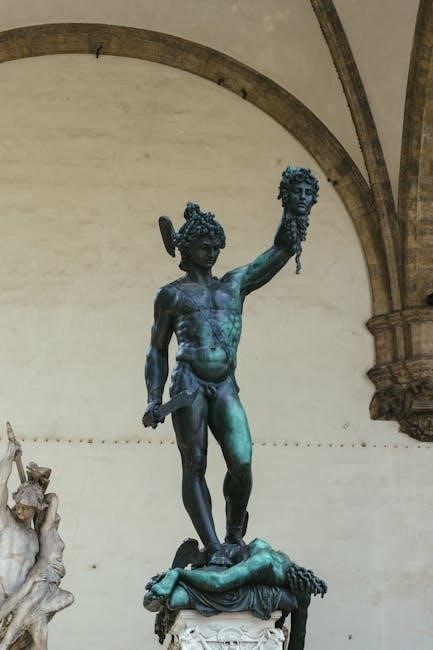
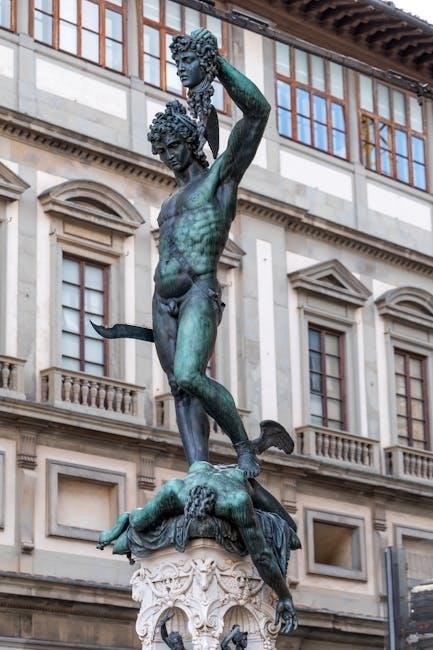
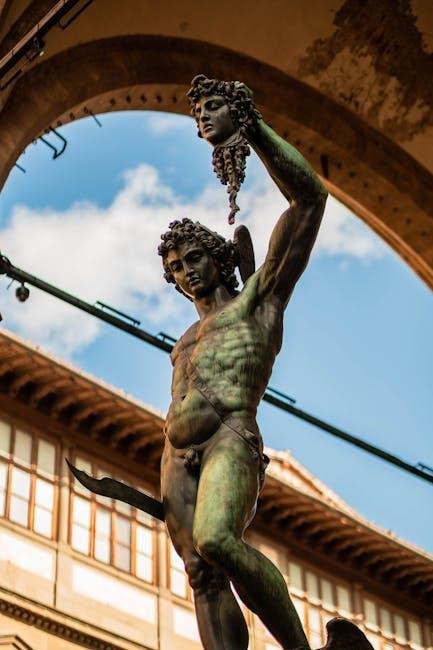
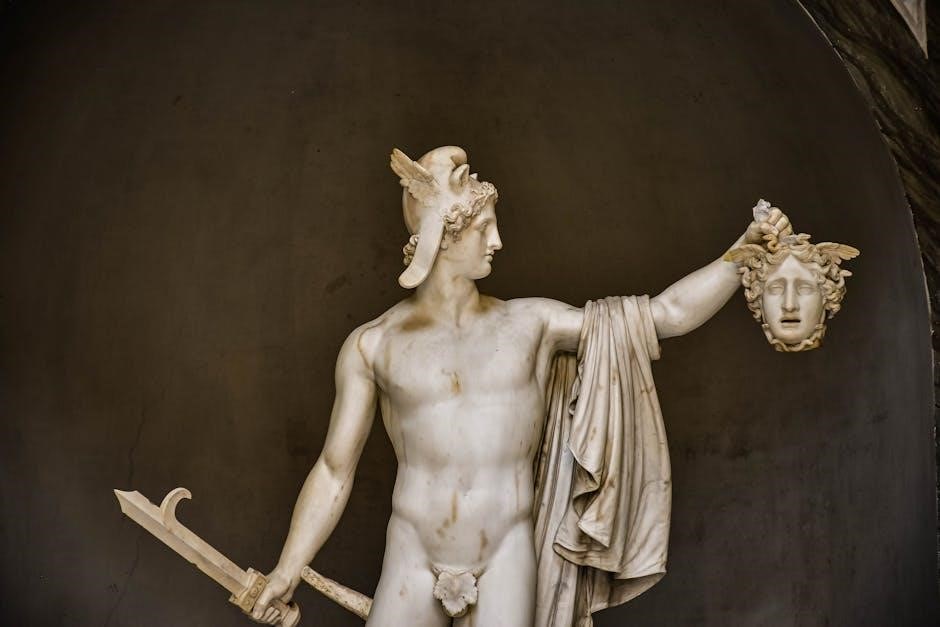
Cellini’s bronze sculpture, Perseus with the Head of Medusa, embodies Renaissance ideals of strength and skill. These works weren’t merely illustrations; they explored themes of courage, divine intervention, and the power of human agency. The Gorgoneion, Medusa’s head, became a popular motif, symbolizing protection and warding off evil, frequently appearing on shields and armor.
Modern Adaptations and Reinterpretations
Contemporary adaptations of the Perseus and Medusa myth often challenge traditional narratives, exploring Medusa’s perspective and reframing her as a victim of patriarchal violence. Authors and filmmakers delve into themes of trauma, female rage, and the complexities of heroism.
Rick Riordan’s The Lightning Thief series incorporates the myth, while Madeline Miller’s Circe offers a sympathetic portrayal of monstrous figures. These reinterpretations demonstrate the myth’s enduring relevance and its capacity to reflect modern social and political concerns.
Perseus and Medusa in Popular Culture
The enduring myth frequently appears in film, television, and video games, showcasing Perseus’s bravery and Medusa’s tragic story to new audiences.
Film and Television Adaptations
Numerous adaptations bring the myth to life, notably Ray Harryhausen’s stop-motion effects in “Clash of the Titans” (1981), vividly portraying Medusa and other monsters. This film cemented the visual representation for many. Later iterations, like the 2010 remake, offer modern special effects, though often diverging from the original narrative. Television series frequently incorporate elements of the myth, sometimes focusing on Perseus’s heroic journey or exploring Medusa’s backstory with greater depth, offering sympathetic portrayals of her violation and curse. These adaptations demonstrate the myth’s continued relevance and adaptability.
Video Game Representations
The myth frequently appears in video games, often as boss battles against Medusa or challenges requiring Perseus’s skills. Games like “God of War” and various RPGs feature encounters inspired by the story, emphasizing combat and puzzle-solving. Developers often reimagine Medusa as a formidable enemy, utilizing her petrifying gaze as a central game mechanic. Some games explore the narrative from different perspectives, allowing players to embody Perseus or even characters connected to Medusa, enriching the mythological experience through interactive storytelling.

The Enduring Legacy of the Myth
The story of Perseus and Medusa continues to resonate, captivating audiences for millennia through its exploration of heroism, violence, and transformation. Its themes of overcoming adversity and confronting monstrous forces remain universally relevant. The myth’s enduring power lies in its adaptability, inspiring countless artistic and literary interpretations. From Renaissance paintings to modern adaptations, the tale consistently sparks new dialogues about power dynamics, female representation, and the complexities of good versus evil, ensuring its lasting cultural impact.